One Soup, A Thousand Arguments: The Borscht Wars Inside Russian-American Kitchens
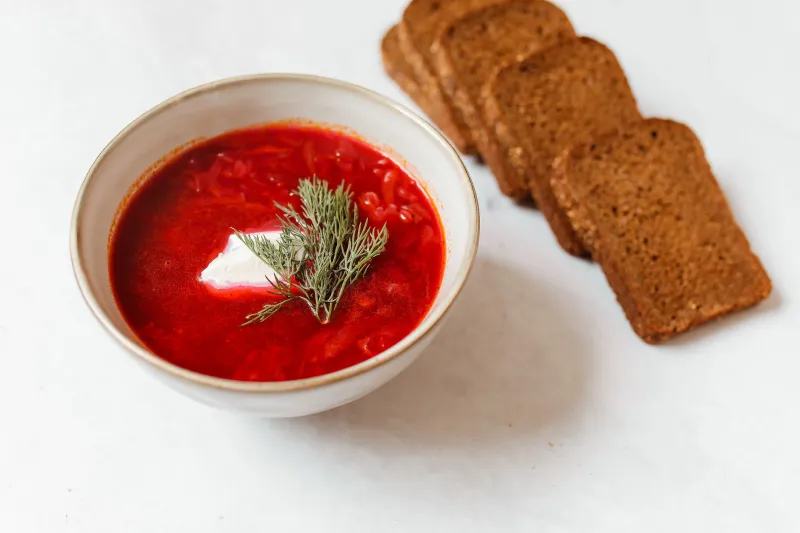
It starts innocently enough. Someone posts a photo of their borscht in a Russian-American community Facebook group — a deep, jewel-red bowl, steam rising, maybe a dollop of sour cream on top. Beautiful, right?
Within twenty minutes there are forty-seven comments.
Where are the beans? You don't put beans in borscht. My grandmother put beans in borscht. That's not borscht, that's just beet soup. Why is it so thin? Why is it so thick? Did you use pork or beef? You used CANNED beets?
Welcome to the borscht wars. Population: every single Russian, Ukrainian, and Eastern European family that has ever immigrated to the United States, all of them absolutely certain that their version is the real one.
The Soup That Contains Multitudes
Here's what makes borscht genuinely fascinating from a food history standpoint: there is no single original recipe. There never was. The soup has been made across Eastern Europe for centuries, and it shifted with every region, every season, every economic circumstance, and every cook who touched it.
The borscht you'd find in Moscow looks different from what a family in Kyiv makes, which looks different from what a Jewish grandmother in Odessa used to serve, which looks different again from what a Polish family in Kraków calls borscht. Some versions are clear broths. Some are thick and hearty. Some are served hot; some are cold summer soups. Some are built on beef bone broth; some are entirely vegetarian. Some contain tomatoes; some wouldn't let a tomato within ten feet of the pot.
And then all of those families immigrated to places like Brighton Beach in Brooklyn, or the Richmond District in San Francisco, or the suburbs of Chicago — and they brought their specific borscht with them. And then America got involved, with its supermarket ingredients and its substitutions and its dietary restrictions, and the soup evolved again.
The result is that borscht in America is less a recipe and more a category. A vibe. A deeply contested vibe.
The Ingredients People Will Literally Argue About
Let's get specific, because the details are where the real passion lives.
Beets: Okay, everyone agrees on beets. This is the one point of consensus. Beyond this, chaos.
Cabbage: Most versions include it, but the cut matters. Shredded fine or in bigger chunks? Fresh or fermented? Some cooks use sauerkraut for a sour punch; others consider this an abomination.
Meat: Beef is common, often cooked on the bone for a rich broth. Pork ribs show up in certain regional traditions. Some families make a meatless version for fasting days that is arguably the most underrated soup in existence.
Tomatoes or tomato paste: This is where it gets heated. Some cooks say borscht isn't borscht without the acidity that tomatoes bring. Others say tomatoes are a 20th-century addition that has no business being in a traditional recipe.
Beans: A genuine fault line. In some traditions — particularly in western Ukraine and parts of Poland — white beans are a standard addition. In others, the very suggestion is met with confusion or offense.
The sour element: Borscht should have a slight tang, but how you get there varies. Tomato paste, sauerkraut brine, a squeeze of lemon, or a splash of vinegar — all of these are in play depending on who's cooking.
Sour cream on top: Non-negotiable for most families. Though even here, some people stir it in and some float it on top, and yes, this matters to someone.
What Borscht Carries Across Borders
Here's the part that goes beyond food science or recipe archaeology. When a Russian-American family argues about borscht, they're not really arguing about beets. They're arguing about memory. They're arguing about which version of home is the real home.
Food is one of the most powerful carriers of cultural identity, and for immigrant communities, it often becomes the last line of defense against assimilation. You can learn English. You can adopt American customs. You can root for a local sports team and celebrate Thanksgiving and call a shopping cart a "cart" instead of a "trolley." But the soup you make on Sunday — that stays.
So when a grandmother insists that borscht must be made her way, she's not being difficult. She's preserving something. She's saying: this is where we come from, this is how we survived, and this specific combination of ingredients is a kind of proof that we existed and that it mattered.
And when her American-born grandchildren make a slightly different version — maybe with vegetable broth because their roommate is vegan, maybe with canned tomatoes because they live in a city where farmers' markets are expensive — that's not a betrayal. That's the soup doing what it has always done. Adapting. Surviving. Carrying the essential thing forward even as the details shift.
A Very Basic Framework (Not a Definitive Recipe, Please Don't @ Us)
For anyone who wants to start their own borscht journey without getting immediately overwhelmed, here's a loose framework that covers the fundamentals most versions share:
- Start with a flavorful broth, whether beef bone, chicken, or vegetable
- Roast or grate your beets — roasting deepens the flavor significantly
- Build a sofrito-style base with onion, carrot, and whatever form of tomato you're using
- Add shredded cabbage and let it soften but not disappear
- Combine everything, adjust seasoning, and add an acid element at the end to brighten the whole pot
- Serve hot with rye bread and sour cream
- Argue with your relatives about what you did wrong
That last step is technically optional but culturally essential.
The Soup That Keeps Evolving
Borscht is, at its heart, a peasant soup — built on cheap vegetables, stretched with whatever was available, adapted to survive hard winters and harder times. It's not precious. It was never meant to be. And that's exactly why it has lasted.
In Russian-American kitchens across the country, borscht keeps changing because the people making it keep changing. New ingredients, new dietary needs, new cities, new generations who learned to cook from YouTube instead of from watching a grandmother's hands. The soup absorbs all of it.
So the next time someone tells you their borscht is the real borscht, listen to them. Ask where the recipe came from. Ask what their grandmother added that nobody else does. The answer will tell you more about Russian culture — its resilience, its regionalism, its fierce attachment to home — than any history book.
And then go make your own pot. It'll be different from everyone else's. That's the whole point.