Babushka Goes Viral: How a Soviet-Era Potato Salad Conquered American TikTok
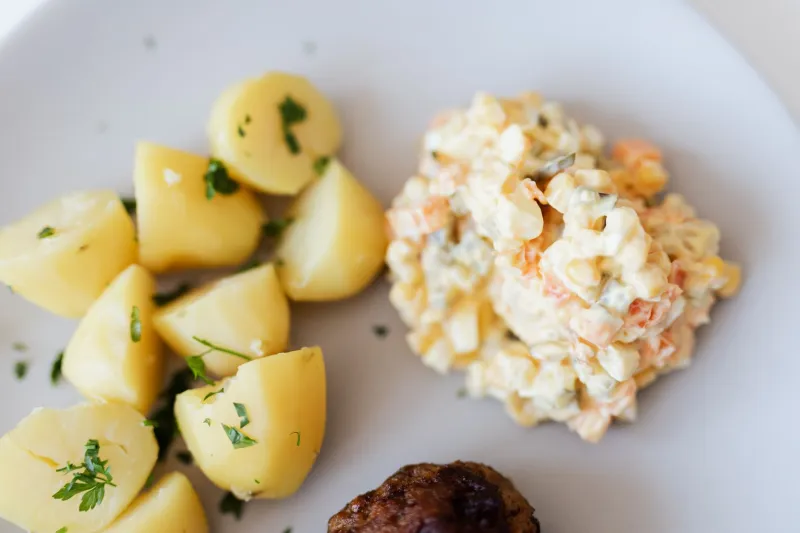
The Salad That Time-Traveled to Your For You Page
If you've spent any time on food TikTok in the last couple of years, there's a decent chance you've stumbled across a video of someone — maybe with a slight accent, maybe with subtitles, maybe just vibing in a cozy kitchen — methodically dicing boiled potatoes, carrots, and pickles into a giant bowl before folding in a truly generous amount of mayonnaise. The comments are always the same mix: "What IS this?" and "I made this and my family lost their minds" and, inevitably, "Babushka said this is the only salad that matters."
The dish is called Olivier salad — or Салат Оливье (Salat Olivye) in Russian — and it has been the undisputed centerpiece of Russian holiday tables since the Soviet era. Now, somehow, it's going viral in Tulsa and Tampa and Tacoma.
How did a recipe born in a Soviet-era kitchen end up trending alongside avocado toast and birria tacos? Pull up a chair. This is a good story.
A Brief History of the Most Important Salad You've Never Heard Of
Olivier salad has a surprisingly glamorous origin story. It was created in the 1860s by a Belgian chef named Lucien Olivier, who ran a famous Moscow restaurant called the Hermitage. His original recipe was a closely guarded secret and reportedly included grouse, crayfish tails, and capers — the full luxury treatment.
Then the Revolution happened. Luxury ingredients became scarce. Home cooks adapted. Grouse became chicken or bologna. Crayfish became canned peas. Capers became pickles. And somewhere in that process of beautiful, resourceful reinvention, Olivier salad became the Soviet comfort food — democratic, filling, and deeply tied to celebration.
For decades, no New Year's Eve table in Russia, Ukraine, or any of the Soviet republics was complete without a giant bowl of it. Families still have their own versions, passed down with the kind of quiet intensity usually reserved for family heirlooms.
From Brighton Beach to the Algorithm
Natasha Petrenko, a home cook and content creator who grew up in a Russian-speaking household in Brooklyn's Brighton Beach neighborhood, posted her grandmother's Olivier recipe almost as an afterthought in December 2022. "I wasn't trying to go viral," she says. "I just wanted to document Babushka's recipe before it existed only in her head."
The video hit 800,000 views in four days.
"The comments were wild," Natasha laughs. "People were saying things like 'this is just Russian potato salad' — which, yes, kind of — but also 'I've never seen anything like this.' Americans kept asking why there was bologna in it. I had to explain the whole Soviet history in a follow-up video."
That follow-up video did even better.
Why Americans Are Obsessed (And It Makes Total Sense)
Food historians and social media analysts who study viral recipe trends point to a few key reasons why Olivier salad hit differently for American audiences.
First, it's genuinely accessible. The ingredients — potatoes, carrots, eggs, pickles, peas, bologna or chicken, mayo — are available at any grocery store in the country. There's no specialty shopping required. That removes a huge barrier that keeps a lot of international recipes from crossing over.
Second, it's nostalgic in a universal way. Americans have their own creamy, mayo-based salads — potato salad, macaroni salad, egg salad. Olivier slots right into that emotional register of "food that means home and comfort" while still feeling excitingly different.
Third — and this is the part that nobody planned — the stories attached to it are irresistible. Every Russian-American creator who posts their version has a Babushka. Every Babushka has a slightly different recipe. Every recipe comes with a memory. That's the kind of content that makes people stop scrolling.
The Hilarious Mistranslations Along the Way
Of course, as with any cultural export, things get a little lost in translation sometimes. American food creators have produced some genuinely creative interpretations of Olivier salad that have Russian-speaking viewers clutching their pearls.
A popular version that circulated on TikTok last winter substituted dill pickles with sweet bread-and-butter pickles ("I mean, they're both pickles" — no. No they are not), used Ranch dressing instead of mayo (a choice that caused genuine distress in multiple comment sections), and added shredded cheddar cheese, which has never in the history of this salad been anywhere near this salad.
"I showed that video to my mom," says Natasha. "She watched the whole thing in silence. Then she said, in Russian, 'This person has never known real sadness.' She wasn't entirely joking."
To be fair, the American creator's video was delicious-looking. It just wasn't Olivier. And that's okay — recipes evolve. But if you want the real thing, here's where to start.
The Real Deal: Authentic Olivier Salad Recipe
This is the version that has lived in Russian kitchens for generations. Simple, honest, and genuinely wonderful.
Ingredients (serves 6-8 as a side dish):
- 4 medium Yukon Gold potatoes, boiled in their skins and cooled
- 3 medium carrots, boiled and cooled
- 4 large eggs, hard-boiled and cooled
- 1 cup frozen green peas, thawed (or canned, drained well)
- 4-5 dill pickles (the real, briny kind — not sweet)
- 6 oz bologna or cooked chicken breast, diced
- 1 small white or yellow onion, finely minced
- ¾ to 1 cup good-quality mayonnaise (Hellmann's works great)
- Salt and black pepper to taste
- Fresh dill for garnish, optional
Directions:
- Peel and dice the cooled potatoes and carrots into small, uniform cubes — about ½ inch. Consistency matters here; it's part of what makes the salad satisfying.
- Dice the eggs, pickles, and bologna (or chicken) to roughly the same size.
- Combine everything in a large bowl — potatoes, carrots, eggs, peas, pickles, meat, and onion.
- Add mayonnaise and fold gently until everything is evenly coated. Start with ¾ cup and add more to your preference.
- Season with salt and pepper. Taste as you go.
- Cover and refrigerate for at least two hours before serving. Overnight is better. The flavors need time to get acquainted.
- Garnish with fresh dill if you're feeling fancy.
Babushka's tip: Make more than you think you need. There are never leftovers.
What Comes Next
Olivier salad isn't going anywhere. If anything, its American moment feels like just the beginning. Russian-American food creators are now introducing their audiences to Vinegret (beet salad), Shuba (the layered herring masterpiece), and Holodets (savory meat jelly — a harder sell, admittedly), all with the same combination of personal storytelling and accessible recipes that made Olivier such a hit.
The algorithm, it turns out, has excellent taste.
And somewhere in Brighton Beach, a grandmother is watching her recipe feed a new generation of curious eaters — one 47-second video at a time.
Want more authentic Russian recipes with the stories behind them? Мой Мир — My World has you covered. Drop your questions in the comments and we'll dig into the archives.